
I’m currently reading Let This Radicalize You by Kelly Hayes & Mariame Kaba and Chapter 4 is “Think Like A Geographer” where they share the following from Ruth Wilson Gilmore:
“One of the things that thinking like a geographer can do is help people see, pull back the veil that makes something that’s social seem natural, and something that sometimes is natural, seem social.” Geography, she said, helps people ask the question, “Why is this place the way it is? Why is it like this?”
About My Vantage Point
I, Kenny, moved to Denver in January, 2005, eager to move to a bigger dance scene and improve my dancing, both Lindy Hop and West Coast Swing. The quality of dancers up and down the Front Range was superb.
By the end of my first or second month in town, I had co-organized the Colorado State Swing Championship, helping that event turn a profit for the first time in some years. From there I worked hard to be asked to join 23 Skidoo, started being part of the regular Mercury Cafe DJ rotation, founded my first national weekend event, taught workshops run through 23 Skidoo, and began teaching regularly at the Mercury Cafe in 2008 or so. I learned up close the marketing efforts Dan & Tiff were pouring into building up their business, their community. It made an impact on me that still resonates today and affects how I market Swingin’ Denver and shared my learnings when helping start schools in Melbourne and Madrid. I’m grateful too for my time within the Swing Patrol ecosystem in London, Berlin and Melbourne getting to see what this organization does which included showering King’s Cross Station with flyers in advance of new classes there, participating in borough parades and how they scouted venues.
Marketing Then
Daniel Newsome, a former Denver swing scene organizer, wrote on his now defunct website in a 2014 blog post titled Why Scenes Sometimes Succeed and Sometimes Fail,
“There is a mindset I see frequently that I call ‘fighting over how to split up $.25 instead of making $1 for everyone.’ I would encourage anyone who needs to work with other promoters, venues or dance schools to try and build their own markets. Try to increase the size of your community, not subdivide it further. If you have a love for what you do and a vision for a better community, I assure you that there are enough students and dancers for everyone.”
From my point of view, him and Tiffiny Wine were go-getters, growing swing nights at the Mercury Cafe into the well known venue behemoth some of us recall it as.
He also talks about the concept of seven touches and they had the resources and drive making this happen. “There is a rule in sales that you must ‘touch’ someone 7 times before they become a client. A touch can be a seeing an advertisement of yours, hearing about you from a friend, an email, a phone call, a Facebook invite etc. make sure that you’re pushing out enough information about your classes and dances that people will hear about it more than once and ideally 7 times.”
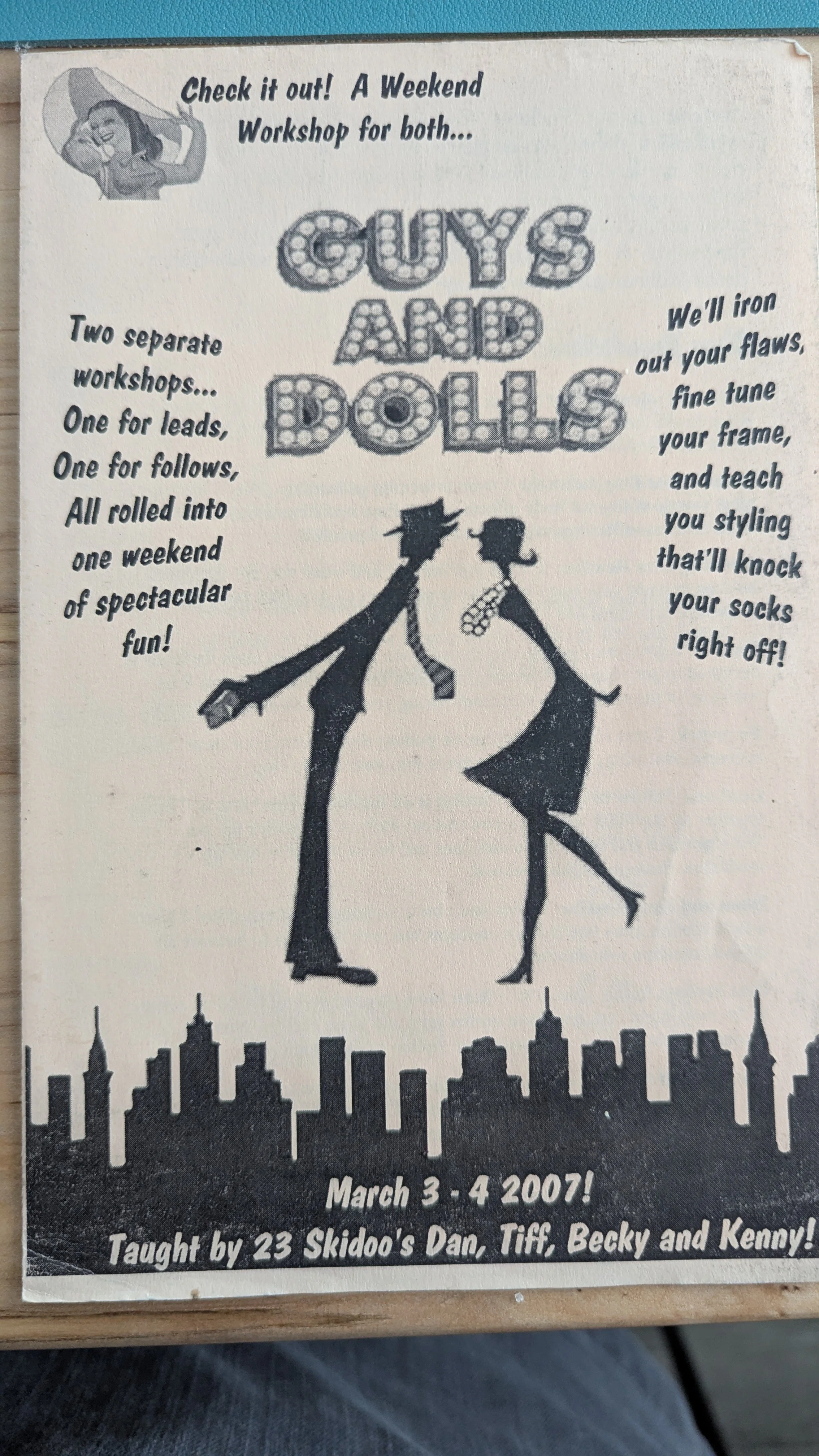
Dan’s aforementioned linked blog post shares how much marketing materials they had plus two college students driving all over metro Denver leaving flyers so people could discover swing nights at the Mercury Cafe. You can see the typical investment they made HERE with images of their Guys and Dolls Workshop material. There were such a variety of touch points for people to discover that the Mercury Cafe was the place to be for a wide swath of individuals first discovering swing dancing.
Another great place to peer into the past is using the Wayback Machine tool for 23Skidooland.com and DenverSwingDance.com. You can also catch a glimpse of the forum with 1,000+ users back when every swing scene had a b2b board.
Marketing Now
Marketing then did a lot to grow and support Denver’s swing scene because, from my POV, Denver Swing Dance, as built by Tiff & Dan, was where scene participants could gather physically and digitally to dance, socialize, get snarky and discover new events. But technology evolves, lifestyles change, exhaustion can set in, new organizers spring up.
Things have been feeling quieter pre and post-pandemic on the marketing front. Print marketing materials are slim, websites are outdated, little progress has been made treating better the Black social dances we dance. New(ish) elements that have been pleasant surprises include:
Sticker nights through Swing Nights launching in 2023
The Triplestep starting and continuing in ground level public spaces and being an inspiration with their social media marketing
Four calendar guides - DenverLindyCal, DenverDanceCal, Alpine Groove Guide, the live Google Doc of local dance events that’s cooperatively sourced.
Blackness and Blues events at Move With Ease (suspended operations)
The immense hustle Joseph Snowhawk lays down promoting his swing dances at the Avalon and how he treats his musician talent.
People speak of fractures but when your main informational hub and gathering space pulls back from their monumental efforts, folks will create new communications methods while others disperse. And, as is shared in Let This Radicalize You:
“As important as these (social media) platforms are, overdependence on them weakens our movements. We need to practice a diverse spectrum of outreach methods in digital spaces and in physical spaces, and we need to do skill-buillding work in our movements around those methods. Sometimes, we need to be literal about meeting people where they are at. Think about all the places people congregate in person and remotely where conversation is possible, from restaurants to school, parks, porchees, places of worship, street fairs, text message threads — and so many more.”
Compare current marketing efforts to this book excerpt - are we meeting people where they’re at so they can organically be introduced to an opportunity to learn how to Lindy Hop? Are organizers sharing their events in Colorado Swing Dance, Denver Jazz Scene, Five Points Neighborhood or Denver Dance Classes (as examples for where people are)? Are organizers providing more than a week’s advanced notice as to who is teaching or providing music (as of 7/18/26, 9 days after publishing, some lead times of 7-10 days being seen)? How and where do citizens discover swing dancing?
Transactional Relationships
Or does it feel that organizers expect you’ll support them simply because they exist? Do they want your allegiance and, if so, what do you receive from giving it?
Around two years ago, I was in the room with a local company’s operations director and social impact administrator as they discussed the feeling they were engaging in transactional relationships with their customer base. In other words, it weighed on them that they weren’t promoting their events more than two weeks in advance which meant they weren’t getting their customer support base excited nor amplifying new customer discovery potential. While paying for the performing talent is an investment, it’s only a piece of the puzzle. To them, it perhaps felt like they were seeking short-term gains instead of cultivating a sustainable community where it invests in the participating people.
Marketing the future
As scene participants contemplate Denver’s venue disruptions which includes Colorado Swing Dance Club’s July 3 closure and Swing Nights losing The Pearl, I find marketing to be a concern. Again, Dan has some great advice from this 2014 blog that’s worth exploring. I’d also encourage the following:
Explore how The Triplestep started and grew with intentionality
Broaden who you follow within your “capital C” Community. If you’re following mostly dancers instead of local establishments, you’re likely only viewing content from people you know through the dance scene. That’s fine to support your friend but you also need to build your audience.
Interact with your Community, meaning local businesses, Front Range venues, adjacent scenes, content creators you like. And by interact, I mean like and like back, comment, repost, share to story, share content you like on your Facebook page, etc. Be a participant, give back, be a supporter and cheerleader. If you’re an organizer, pop into your IG settings and review your interactions. If you’re a community member, consider interacting with your swing orgs’ posts, reposting what’s happening, sharing directly with a friend, even seeing who they’re following and supporting in case you’d want to do the same.
Create printed materials (pay artists, avoid AI and generic Canva images modeled after white bodies) and distribute heavily!! Increase marketing, increase accessibility.
Ask for advice from a wide range of scene participants. If you don’t know all the spaces where people interact, ask and find out. Develop your curiosity.
Share dance opportunities in dance, music and neighborhood Facebook groups.
Create a Google Business Profile, market there, add photos, utilize the announcement option
Invest in advertising with Google and/or Meta
Consider offering discounted dance lessons on Groupons and equivalent platforms
Summary
There are so many ways to market and it’s exhausting to do it well in order to create a sustainable gathering place. It’s why I don’t run weekly classes and monthly dances anymore outside of Swingin’ Denver’s strategic partnerships.
When I suspended our 2022 events ahead of my holiday market work and second child’s birth, I had some hope to restart. It literally felt like I was getting up from a reclining position on the sofa to only sink back down. I knew I couldn’t market to the fullest of my ability and didn’t know who to ask, who to rely on. Marketing well, in my opinion, is consuming, tiring work and there’s still the uncertainty if there will be a payoff, whether emotional and/or financial.
While I accepted seeing my marketing mentors pull back all those years ago, I didn’t understand it. I do now. I get it. And they were in a good position to pull back. Over the years it seemed a scarcity mindset eventually set in and entrenched itself rather than gathering enough ingredients to make more “pie.” The students are out there. They just need as many touch points as possible to find you.