Teaching

Social Dances Have Names

Some of the shortest statements are the most impactful ones. When Taylor Madgett at Dance Dance Evolution firmly stated “Black social dances have names” at the beginning of her class when she was contrasting Black social dances with studio dance, it lodged into my brain. Much like - “The term vernacular refers to dance performed to the rhythms of African American music: dance that makes those rhythms visible.” from Steppin' on the Blues - this statement has become a touchstone for my teaching and teacher instruction, most recently being shared during our Little Man Ice Cream Swingin’ Under the Stars teacher training.

As my co-instructor pointed out during the teacher training, we both get a little irked when we see local swing dance schools continue to teach East Coast Swing and Jitterbug classes. As another school’s instructor shared when asked what a Jitterbug lesson was - “It was east coast. I asked why it was called a Jitterbug lesson and he said because it is very beginner swing dance. And the most important descriptor that stood out to me was that [name redacted] said that it’s very white. Like the most white. That it’s up pulse instead of down in the ground like lindy hop.”

"Nowadays if you say Lindy Hop there are very few people who know the word. You know you say Lindy Hop and they just look at you you know. What is that? And then you say uh jitterbug and their face light up because they have heard Jitterbug for so long till they think that's what it is." - Frankie Manning in Swingin' at the Savoy: The Frankie Manning Story.

“But why then, when I took dance classes in school, was I not told that Lindy Hop came from the Black community?“

This separation (Jitterbug = beginner swing dance) and centering in whiteness does more harm than good within our vernacular dance community. Lindy Hop is easy to learn, difficult to master. However, thanks to particular instructors and swing schools, we have many people that think Lindy Hop is hard, fast, too athletic because we have this “different dance” over here that is an appropriated commodified version of Lindy Hop further distilled (“tamed”) from what Arthur Murray originally did. I was in the thick of it in the 1990s and know why Jitterbug happened. It’s surprising JItterbug’s legacy has lasted this long since neo-swing crumpled and Jitterbug is attached to my parents’ and grandparents’ generation. As Gaby Cook wrote here, “Language like ‘East Coast Swing’ belongs to the practice of white people siphoning black innovation and repackaging it as a ‘safe’ white cultural product.”

From one swing dance school’s website

"The key elements are the implications that the jitterbug was a dance that was out of control, whereas the Lindy Hop was indeed a theatrical performance, one that Martins attests that "of all the ballroom dances these prying eyes have seen, this is unquestionably the finest; but let the white man attempt it at his peril." - The Oxford Handbook of Dance and Theater.

The other reasons that Jitterbug and East Coast Swing lessons are still pervasive with schools that teach Lindy Hop and other vernacular dance styles are likely marketability, white comfort, organizers resistant to the work involved when evolving, holdovers from the late 1990s neo-swing era, and whitewashing of Black history.

If we are to be better guests in Black social dancing’s house and, rather than be cultural appropriators, be cultural surrogates as defined by LaTasha Barnes, then changes need to be made.

  • Swing dance schools ought to stop branding Lindy Hop classes as East Coast Swing and Jitterbug. Since Lindy Hop comprises of many different visible-on-the-dance-floor rhythms, teachers should be comfortable teaching and dancing a variety of rhythm patterns including step, step, rock step while folding it into vernacular dance values like call-and-response, improvisation, the aesthetic of cool, etc. Let’s start avoiding the neo-swing era with its further appropriation and commodification of Lindy Hop now.

  • When renaming your class “Lindy Hop Taster” or “Level 0 Lindy Hop,” accompany your marketing with appropriate school-sourced video of teachers dancing what your school will be teaching. Include appropriate fun imagery, emphasize the beginner-friendliness of what you’ll be teaching and make some statements on social media and your website about why you’re making the change. Perhaps this will make your classes more accessible and inclusive.

  • Continue to educate. Your website and social media presence should be a resource and a marketplace. Many people treat their social media platforms as places to sell things, but it should also be a resource. And then make sure your classes are educational on several fronts - music, history, dancing, consent, etc.

We can do better.

Another school’s website where they center Black social dances with their origins and using the dances’ names.

Planning for Active Shooter Situations Resources

In light of the shooting at the Monterey Park dance studio January 21, 2023, we would like to share some resources we’ve gathered from our work in the events industry.

Someone I know that was formerly in a Public Safety role at a U.S. shopping center provided me this presentation they prepared to train staff in active shooter preparedness.

It's meant to be self-guided and I do have permission to distribute this. Sharing settings are "View" and it appears you can download this and then upload to your own Drive to customize it to your needs. The original owner did have a logo in the left corner.

If you have any questions, feel free to ask, but I anticipate not being able to answer due to the fact that I'm still learning. Hope you find this helpful.

Special Events Emergency Plan for an outdoor event I produced in 2020 so you can see what Denver has required of event organizers before.

Training for an Active Shooter Situation notes.

DHS - Active Shooter How to Respond.

NRF Active Shooter Guidelines.

Pottery & Lindy Hop - Philosophies Merge

Today I attended the O’baware Summer Sale in Lafayette. Not only did I find excellent pottery to purchase, but I had the opportunity to listen to Kazu Oba, the Japanese-trained pottery artisan, talk about his methods and philosophy.

One particular element struck me was when he was talking about the piece pictured in this blog and I’ll try to be accurate as much as possible with this retelling. This particular piece is shaped cylindrical on the wheel with the vertical lines representing Kazu’s fingers as he draws the material upward. At some point he slices this cylinder into three pieces and drops the wet clay from a slight height for it to flatten.

However, the clay remembers that it was round and part of a whole so it tends to recoil round, so Kazu must work it flatter, but you’ll still see the edges curl upwards. The clay remembers.

This is in contrast with other potters that might start with a flatter piece of clay and try coiling the ends. However, Kaza was saying something akin to him not wanting to impose his will on the clay. He prefers his method of providing the clay a memory and guiding that memory to form something unique. This was my takeaway.

This led me to reflect briefly upon dance teaching. While these thoughts aren’t fully formed, I’d say there is a remarkable difference between how I was trained to teach ballroom dance (specific foot placement, specific technique, specific syllabi, imposition of will) versus how we teach Lindy Hop (acknowledging ambiguity, welcoming expression, striving to improve those triple step rhythms and moving from core). You can bring your lived experiences to vernacular dance and they can inform your interpretation of your teachers’ expressed philosophies whereas ballroom (I’ll acknowledge not all) can be cookie-cutter and formulaic.

Sometimes one style works best for a person. Sometimes you start with ballroom and move to Lindy Hop, sometimes you move the other direction. And I think it’s good to offer options so dance can meet people where they are at.

The Dance is Called Lindy Hop

Here's an excerpt from a conversation about urban dance that we can see reflected in current naming struggles within the Lindy Hop community. "Urban is problematic because it is not a racial term. It eliminates race. You're taking away the people from the dance."

You can likely draw a line from this statement to swing schools and instructors utilizing terms such as "jitterbug" or "east coast swing" to label classes teaching Lindy Hop with slow and quick rhythms. Whether their intentions are good or not, the more we get away from the origins, the more we erase Black ownership. And, while names change as things evolve, what people call "east coast swing" or "jitterbug" was a devolving or simplification of Lindy Hop.

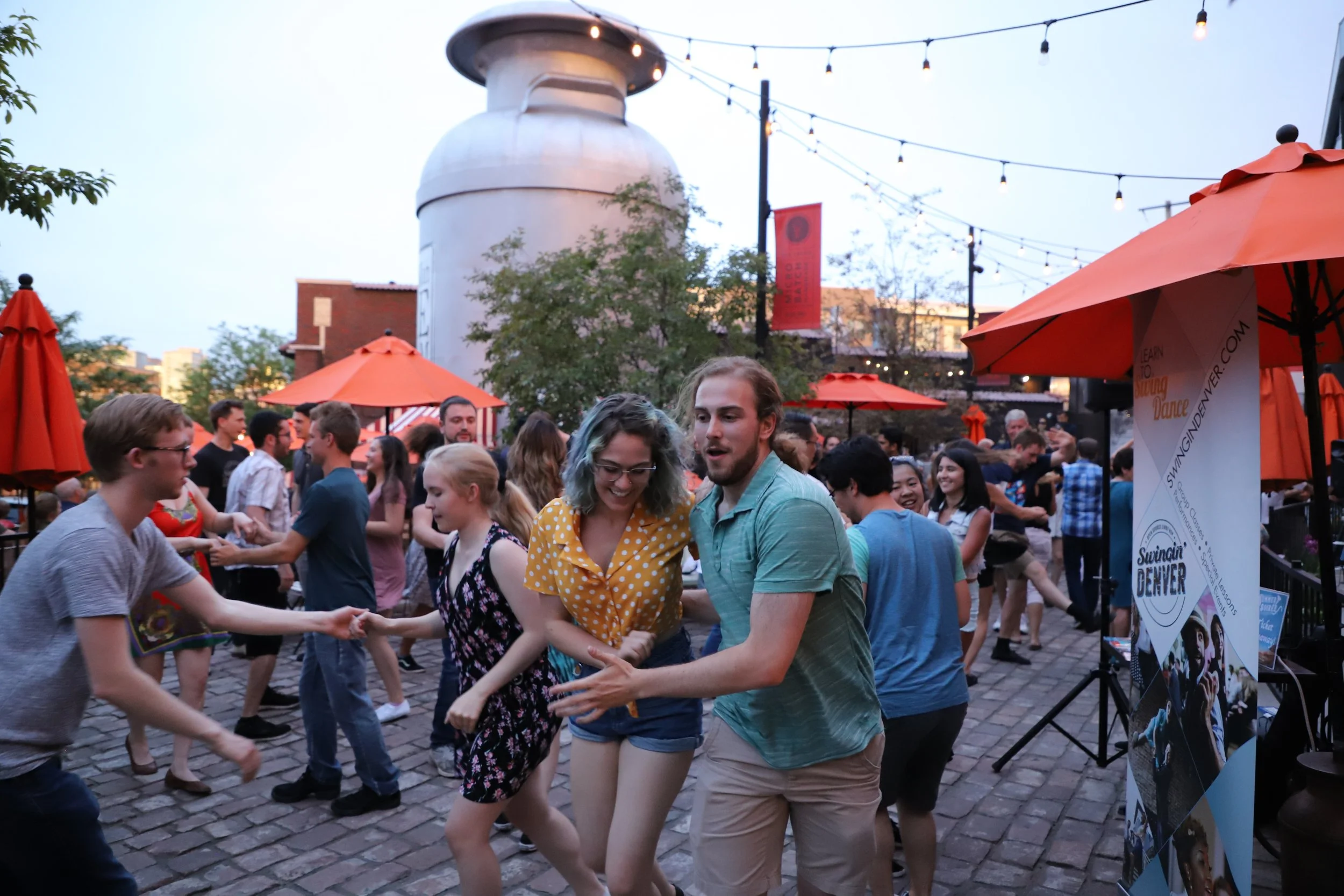
Swingin' Denver has long since scrapped our own Jitterbug classes, but up until 2019, we had called the beginner swing dance classes we taught at outdoor events "beginner swing dance," jitterbug" or "east coast swing." We did not call it Lindy Hop.

Only after a lot of reading and listening during the pandemic did we make the switch which has been even more emphatic this year. My thoughts and feelings had finally firmly coalesced that we would confidently state we are teaching Lindy Hop with its vernacular dance hallmarks while teaching a particular rhythm (slows and quicks) danced to excellent swing music.

I'm happy to be in this spot since we are now more consistent with what we offer, believe and support. We could not celebrate Lindy Hop, a Black social dance, in one hand and erase the Black origins in the other.

We still have more growing and learning to do, but I wanted to share these thoughts with our audience. I hope other swing dance school will reach these conclusions soon.


Allowing Students Space To Find The Dance

One thing I've learned over the years, and this could be why I gravitate toward or value particular teachers, is to provide space for students to find the dance. From Peter Strom - "Many people come absolutely bereft saying 'please tell me what to do.'" And this is a fine place to be. After all, students are coming to learn, start a new hobby, join a community.

It's the teachers' job to teach culture, movement vocabulary, music appreciation and more, and then step aside. This could take the form of playing whole songs for the students to dance to, providing time for students to workshop ideas, or teach patterns that encourage call-and-response from students.

And then provide encourage, shout praise, give a thumbs up, make eye contact and nod "I see you," bring students up to demo what they've accomplished and/or created, or even dance demo what you saw from students as a way of encouraging greater exploration and then quickly turn the music back on.

As I state in the teacher trainings I lead - Lindy Hop is dynamic, full of choices, and ambiguous at times. You just have to believe your students are capable and project that belief to them, so they can believe it to and become independent dancers dancing as themselves.

Call-and-Response - In The Pocket

Last Friday, I attended a staged reading of Jeff Campbell's new play "In The Pocket: The Ballad of Bobby Trombone.” at The Savoy Denver. This was a collaboration between Emancipation Theater and Theatre Artibus.

One section that stood out was the first time Shane Franklin broke out his tap shoes to involve the audience by rhythmically tap dancing and getting us to respond with “in the pocket.” In the pocket, as you can likely guess from the play’s title, was a recurring theme. Since things can get lost in writing, I’ll say it was very similar to Frankie Manning calling out “uh1, uh2, uh you know what to do” - very rhythmic, timed, leaving space for the response of Shane’s taps’ calls to audience members. Innnn the Pocket.

And that got me thinking. Can we at Swingin’ Denver get our students more audibly involved in a similar way? And could that help them find Lindy Hop’s pocket?

Uh 1 Uh 2
We Know What To Do!

Food for thought

March 2022 Class Playlist

I am ridiculously pleased with the amount of music we played opening night in both our Intermediate and Beginner Lindy Hop classes! 50+ minutes were played and we were maximizing students’ dance time. The same goes for Boulder Swing Dance too!

These are the classes I love to teach and participate in - where it’s movement focused and we can put into practice what we’re learning to music. Anyway, we’re building a Spotify playlist of music below that students are dancing to in class.

Embed Block
Add an embed URL or code.

Get Out Of The Way Of The Dance

Lindy Hop speaks for itself. It’s wonderfully dynamic, playful and powerful. As Jacqui Malone writes “its hallmarks are improvisation and spontaneity, propulsive rhythm, call-and-response patterns, self-expression, elegance, and control.” A Lindy Hop social dance rarely repeats itself because the partner, the song, and your life experience are rarely the same at that moment in time.

So why do some lindy hop instructors get in the way by trying to share the dance verbally when it’s a physical expression? When teaching, strive to let your dance students experience Lindy Hop through dancing as much as possible, especially dancing to swing music. This is because, as I sit here and reflect on my past dance experiences, there is nothing quite like dancing it out for yourself, dancing through mistakes, and trying to connect to a different partner to a new section of music. Lindy Hop is best experienced kinesthetically.

So let’s dance more and speak less.